For general contractors, commercial real estate developers, and building material wholesalers in North America, Australia, and Europe, sourcing architectural fenestration directly from Chinese manufacturing hubs has become the ultimate strategy for maximizing project margins. However, purchasing high-value architectural glazing across borders involves far more than simply comparing factory unit prices.
Without a clear grasp of international structural codes, ocean freight logistics, customs classifications, and quality verification, importers risk costly site delays and customs compliance rejections.
This comprehensive roadmap breaks down how to import aluminum doors and windows from China smoothly, securely, and cost-effectively.
Step 1: Regional Code Compliance & Certification Benchmarks
Before signing any purchase contract or approving extrusion drawings, you must confirm that the Chinese manufacturer can produce systems that comply with your local municipal building codes. High-performance aluminum window systems must meet verified structural and thermal thresholds:
- United States & Canada: Requires compliance with AAMA/WDMA/CSA 101/I.S.2/A440 (NAFS standard). Glazing units must carry NFRC (National Fenestration Rating Council) ratings for U-factor and Solar Heat Gain Coefficient (SHGC). In coastal jurisdictions like Florida, systems must meet Miami-Dade or Florida Building Code (FBC) High-Velocity Hurricane Zone (HVHZ) impact standards.
- Australia & New Zealand: Must strictly comply with AS 2047 (windows in buildings – selection and installation) and AS 1288 (glass in buildings – selection and installation), accompanied by NATA-accredited test reports.
- Europe & UK: Requires the CE mark and UKCA mark, verifying conformity with EN 14351-1 for external pedestrian doors and windows.
Step 2: Evaluating Material Specifications Beyond the Price Tag
When learning how to import aluminum doors and windows from China, avoiding corner-cutting requires specifying exact raw material standards in your Purchase Order (PO):
| Component | Standard Commercial Grade (Avoid for Export) | Architectural Export Grade (Specify This) |
| Aluminum Ingot Quality | Recycled secondary aluminum scrap | 100% Primary Billet 6063-T5 / 6063-T6 |
| Profile Wall Thickness | Below 1.4mm (Risks structural deflection) | Minimum 1.8mm – 2.0mm+ for heavy-duty systems |
| Thermal Barrier Strip | Low-grade extruded PVC (Cracks over time) | German-standard PA66 GF25 Polyamide Strips |
| Glass Quality Standards | Uncertified local float glass | SGCC / CE / AS/NZS 2208 certified tempered IGU |
| Corner Assembly Method | Simple screw joint with standard silicone | Pin-locking corner cleats with 2-part glue injection |
Step 3: Navigating Harmonized System (HS) Codes & Customs Duties
Accurate product classification avoids severe customs penalties and anti-dumping tariff surprises upon container discharge:
- HS Code 7610.10: Classifies Doors, windows and their frames and thresholds for doors, of aluminum.
- HS Code 7008.00: Classifies Multiple-walled insulating units of glass (relevant if glass is shipped unglazed or separately).
Pro Tip for US Importers: Ensure your freight forwarder reviews the current Section 301 tariff exclusions and countervailing duty classifications before dispatching goods from Chinese ports.
Step 4: Factory Vetting & Production Quality Assurance
Do not rely solely on staged catalog renderings. When vetting a Chinese source factory, enforce a strict quality control (QC) sequence:
- CAD Shop Drawing Sign-Off: The manufacturer must provide 1:1 CAD shop drawings showing structural profile sections, drainage weep holes, gasket pathways, and anchor clip points before machining begins.
- First-Piece Mockup Inspection: For multi-unit developments, require a full-scale physical corner sample or completed mockup window to verify finish smoothness, corner alignment, and gasket tightness.
- Pre-Shipment Factory Water & Air Testing: Reputable factories utilize in-house airtightness, watertightness, and structural test chambers to test random units from your batch before crate packaging.
Step 5: Export Packaging & Ocean Logistics Protection
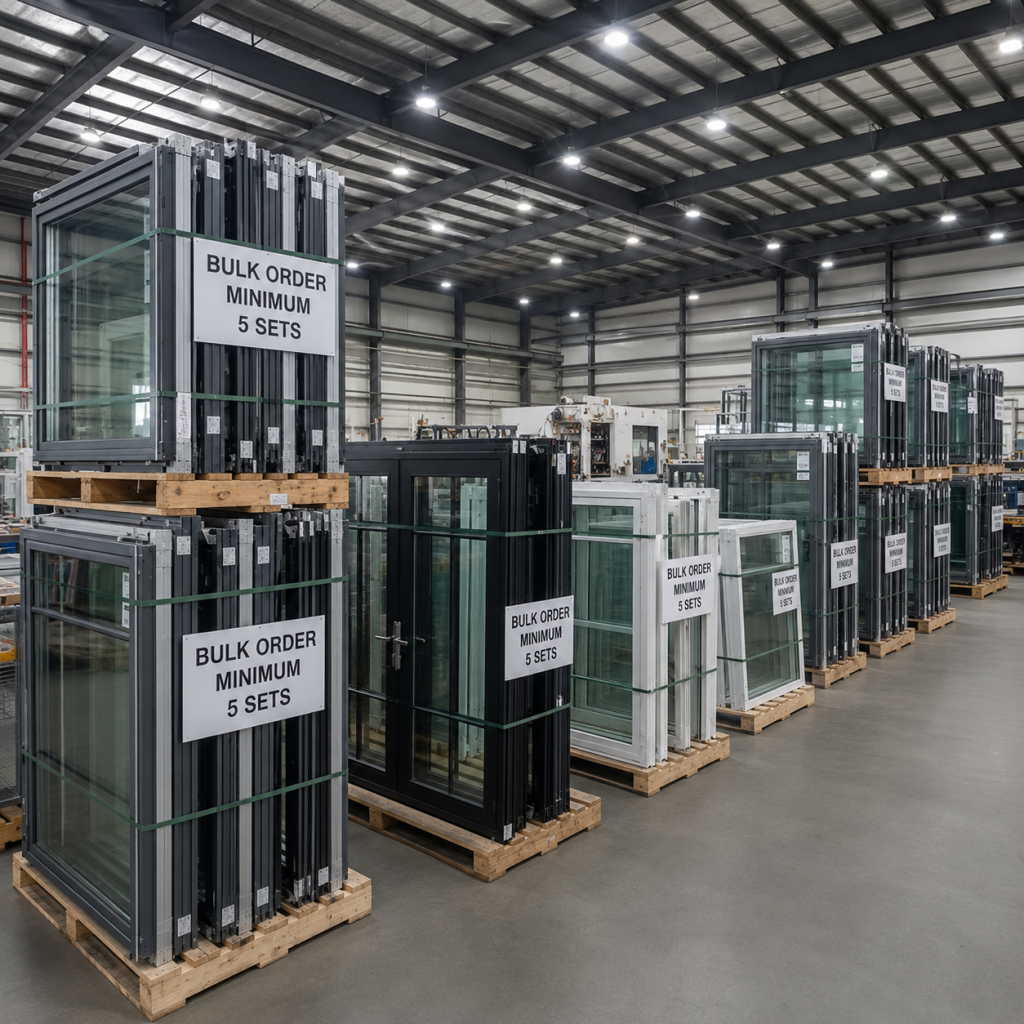
Glass breakages and frame scratches during ocean transit are the most expensive risks when importing fenestration products. High-standard export packaging must incorporate:
- Full Face Protection: High-tack PE protective tape over all visible powder-coated or PVDF profiles.
- Shock-Absorbing Corner Pads: Heavy-duty molded rubber corner protectors on every sash.
- Fumigation-Free Plywood Crates: Solid, customized plywood crates lined with thick EVA shock-absorbing foam. All crates must feature heavy steel strapping and integrated bottom skids for seamless rough-terrain forklift handling at destination ports.
Step 6: Step-by-Step Payment Terms & Order Execution Timeline
A standard, low-risk procurement cycle for custom architectural doors and windows spans 45 to 65 days from engineering sign-off to port departure:
- Deposit & Engineering Phase (Days 1–10): 30% T/T deposit following final confirmation of shop drawings and hardware choices.
- Precision Fabrication (Days 11–35): CNC extrusion cutting, punching, thermal strip insertion, corner glue injection, and glass unit assembly.
- Quality Inspection & Video Audit (Days 36–40): Factory live-stream inspection or third-party QC audit (e.g., SGS / Intertek).
- Balance Payment & Loading (Days 41–45): 70% balance paid against the Bill of Lading (B/L) copy or pre-shipment container loading inspection.
Frequently Asked Questions (FAQ)
Q1: Is it cheaper to import fully assembled windows or knock-down (CKD) kits?
Fully assembled and glazed windows guarantee factory-controlled corner sealing, water tightness, and structural glue curing. While Knock-Down (CKD) profile kits save ocean container volume, they require specialized assembly tooling and certified glazing labor on your domestic job site, which frequently negates the shipping savings.
Q2: How can I safely pay a window manufacturer in China?
The industry standard for custom manufacturing is a 30% T/T deposit upon order confirmation and 70% balance payment upon presentation of the ocean Bill of Lading (B/L) and pre-shipment inspection photos. For large commercial projects, an irrevocable Letter of Credit (L/C at sight) is widely accepted.
Q3: What happens if a glass panel arrives cracked at the port?
Partnering with an experienced export manufacturer ensures that cargo is covered by comprehensive Marine Cargo Insurance (CIP/CIF terms). In addition, quality-focused suppliers often include spare gasket rolls, extra hardware packs, and optional replacement glass panes inside the container for immediate project continuity.
Source Directly from ANKEN’s Manufacturing Facility
Understanding how to import aluminum doors and windows from China gives contractors and developers a substantial competitive edge in quality, structural customization, and project ROI.
At ANKEN, our manufacturing center engineers and fabricates bespoke aluminum sliding doors, thermal break casement windows, and smart LED glass railing systems built to international building standards. We manage the entire lifecycle—from CAD shop drawing engineering to heavy-duty export crating.
Contact ANKEN’s Export Engineering Department today to request a factory-direct quote or review our structural project portfolio