
When I began planning the major renovation of our two-story modern family home in Melbourne, I was determined to install expansive, black-framed sliding patio doors and modern casement windows. However, when local window showrooms quoted me astronomical figures that consumed nearly half my total finishing budget, I knew I had to explore direct manufacturing. That decision led me down the rabbit hole of international sourcing, where I quickly encountered the crucial debate: thermal break vs non thermal break aluminum windows.
Online forums were filled with warnings. Homeowners shared horror stories of buying cheap metal windows that “sweated” constantly during winter, peeling drywall and breeding black mold.
Here is my true story of finding an architectural manufacturer on social media, ordering corner cut samples, and learning how to inspect the profiles so you never get tricked by counterfeit insulation barriers.
The Social Media Discovery: Finding a Real Factory in Foshan
Like many self-builders, my journey started late at night on Instagram and YouTube. I was watching architectural home tours when the algorithm served me a short video showing an automated CNC extrusion line precision-cutting heavy aluminum window profiles. Unlike typical drop-shipping accounts with stock 3D renders, this page posted real-time clips directly from a factory workshop in Foshan, China. The company was ANKEN.
I reached out via direct message with my window schedule and preliminary architectural floor plans. Within 24 hours, an export project engineer replied not with a pushy sales pitch, but with technical CAD shop drawings and an honest question:
“Your climate in Melbourne experiences sharp winter drops down to 3°C and summer spikes above 38°C. Are you specifying non-thermal frames or multi-chamber thermal breaks?”
That simple question forced me to research the structural differences before committing thousands of dollars.
Understanding the Core Engineering: How the Two Systems Differ
Before authorizing mass production, I requested physical corner cut samples shipped to my doorstep via DHL. Holding the physical extrusion cross-sections made the structural differences immediately obvious:
Non-Thermal Break: [ Single Solid Aluminum Extrusion (Direct Heat/Cold Highway) ]
True Thermal Break: [ Outer Aluminum Profile ] ➔ [ PA66 GF25 Polyamide Barrier ] ➔ [ Inner Aluminum Profile ]
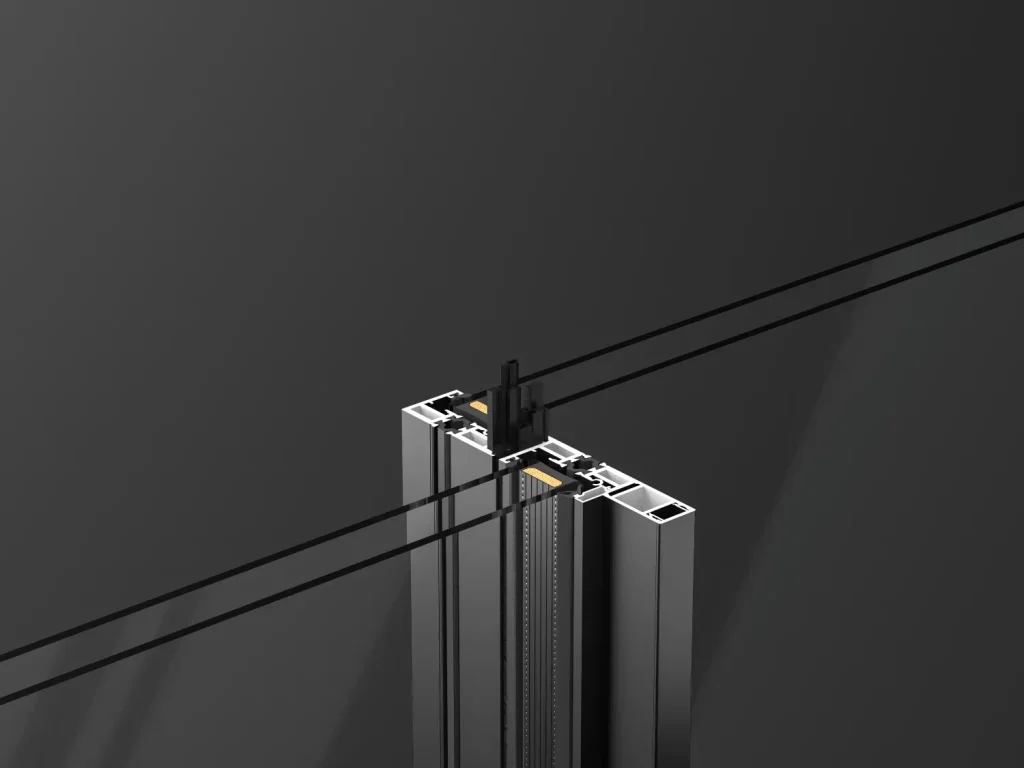
What is a Non-Thermal Break Profile?
A non-thermal window frame is extruded as a single, uninterrupted piece of solid aluminum alloy. While aluminum is exceptionally strong, lightweight, and modern, it is also a thermal super-conductor. Heat and cold travel through solid aluminum instantly. On cold winter nights, the outdoor freezing temperature transfers directly into the indoor frame, chilling the interior room and causing moisture in the air to condense into running water droplets along your frames.
Before placing an order, understanding the structural physics of thermal break vs non thermal break aluminum windows helps prevent costly replacement errors.
What is a Thermal Break Profile?
A thermal break frame physically divides the aluminum extrusion into two completely separated interior and exterior halves. These two aluminum chambers are structurally joined by a non-conductive, glass-fiber-reinforced structural insulating strut. This structural barrier interrupts (or “breaks”) the thermal conduction pathway, stopping radiant outdoor heat from entering during summer and keeping indoor warmth locked inside throughout freezing winters.
4 Practical Tests: How I Inspected My Corner Samples
When comparing thermal break vs non thermal break aluminum windows, dishonest brokers sometimes take advantage of overseas private buyers by inserting cheap plastic strips to simulate high-end systems.
Here is the exact 4-step checklist I used on my workbench to verify genuine thermal insulation:
1. The Cross-Section Seam Inspection
Look closely at the profile’s cut edge:
- Non-Thermal: The metal is completely continuous from the exterior face to the interior face with no structural seams.
- Thermal Break: You will clearly see three distinct elements: an exterior aluminum shell, a dark structural composite strip in the center, and an interior aluminum shell. The aluminum teeth should be mechanically rolled and knurled tightly into the strip’s grooves.
2. The Lighter Flame Test (PA66 vs. Cheap PVC)
This is the ultimate field test. Authentic architectural thermal breaks must be manufactured from PA66 GF25 (Polyamide 66 reinforced with 25% glass fiber). Low-end workshops often substitute cheap, brittle extruded PVC plastic:
- The Test: I took a standard pocket lighter and held a low flame to the exposed black insulation strip on the sample for 5 seconds.
- The Result: Cheap PVC melts rapidly, emits a harsh, acrid chemical odor, and blackens into a sticky residue. Genuine PA66 GF25 resists immediate ignition, will not drip, emits a smell similar to burning hair or wool, and leaves a rigid, fibrous edge due to its glass-fiber reinforcement.
3. The Surface Hardness & Scratch Check
- Authentic PA66 GF25 exhibits a matte, slightly textured surface with visible microscopic glass fibers. It feels as rigid as metal and cannot be easily gouged with a fingernail or a standard coin edge.
- Low-grade PVC looks glossy, feels smooth and soft, and scratches deeply under minimal pressure. In real-world installations, PVC degrades under intense solar UV exposure within two years, leading to structural separation.
4. Thermal Camera Verification
To test heat dissipation, I placed both sample corners into my kitchen freezer for 30 minutes. Upon taking them out:
- The non-thermal aluminum sample was freezing cold across its entire surface, and within three minutes, water condensation formed heavily on the inside surface.
- On the thermal break sample, the exterior aluminum face was ice cold, but the interior aluminum chamber remained at room ambient temperature, staying completely dry without a drop of condensation.
This detailed performance matrix outlines the structural and energy differences between thermal break vs non thermal break aluminum windows.
Technical Comparison Matrix: Non-Thermal vs. ANKEN Thermal Break
| Technical Specification | Standard Non-Thermal Aluminum | ANKEN High-Performance Thermal Break |
| Frame Architecture | Continuous solid 6063-T5 aluminum | Multi-chamber 6063-T5 + 34mm PA66 GF25 barrier |
| Thermal Conduction | Rapid metal-to-metal heat transfer | Completely isolated interior/exterior chambers |
| Whole-Assembly U-Factor | 0.55 – 0.70 BTU/(h·ft²·°F) | 0.18 – 0.22 BTU/(h·ft²·°F) (U-value ≤ 1.15 W/(m²·K)) |
| Condensation Resistance | Poor (Frequent frame sweating & mold) | Superior (Eliminates interior cold-bridging) |
| Acoustic Isolation | Basic sound reduction (STC 26–28 dB) | Enhanced noise dampening (STC 36–42 dB) |
| Ideal Application | Interior partitions, warm climates | Exterior residential & commercial facades |
From Production Approval to Port Arrival
Satisfied that ANKEN used certified virgin billet 6063-T5 aluminum and authentic Technoform PA66 GF25 thermal strips, I approved the 1:1 CAD shop drawings for my whole-house window and door package.Evaluating thermal break vs non thermal break aluminum windows on site convinced me to invest in certified multi-cavity insulation profiles.
The production journey took roughly 35 days, during which the engineering team sent me milestone video updates:
- CNC Mitering & Punching: Double-head saws cutting extrusion profiles to exact millimeters.
- Corner Cleat Glue Injection: Corner brackets mechanically pinned and injected with two-component structural epoxy to prevent future corner leakage.
- Heavy-Duty Export Crating: Glazed units were wrapped with protective PE film, fitted with corner guards, and packed into solid, fumigation-free plywood crates with internal EVA foam padding.
The Container Delivery
The crates arrived at the Port of Melbourne after 18 days at sea. Everything cleared customs under HS Code 7610.10 without fumigation holds. When we unpacked the crates on site, all 22 window assemblies and the massive 3-panel panoramic sliding door were completely intact without a single scratch or hairline fracture.
Summary Checklist for Private Sourcing
When deciding between thermal break vs non thermal break aluminum windows for your custom build, remember these golden rules:
- [ ] Request physical corner cut samples before signing a full production contract.
- [ ] Perform the flame and scratch test on the insulation strip to rule out cheap PVC.
- [ ] Verify primary billet 6063-T5 aluminum with wall thickness of at least 1.8mm – 2.0mm.
- [ ] Confirm dual-component corner glue injection rather than simple dry-driven screws.
- [ ] Ensure all export wooden packaging uses non-fumigation engineered plywood.
Build Your Dream Home with ANKEN
Understanding thermal break vs non thermal break aluminum windows empowers private builders and homeowners to invest in long-term comfort, structural safety, and significant energy savings.
At ANKEN, our manufacturing center in Foshan engineers bespoke architectural aluminum doors, windows, and glass railing systems built to international building codes. Whether you are building a custom modern home or managing a commercial development, we offer full design transparency, 1:1 CAD shop drawings, and secure ocean export packaging.
Ultimately, choosing thermal break vs non thermal break aluminum windows comes down to balancing project climate demands with long-term energy savings.
Contact ANKEN’s Technical Support Desk today to request sample cross-sections or submit your blueprints for a factory-direct evaluation.